
Your Oversplit Might Be Doing More Harm Than Good

What athletes need to know about extreme flexibility training.
For athletes in sports like dance, gymnastics, cheer, figure skating, martial arts, and other activities that require significant flexibility, being able to move through a large range of motion can feel like an advantage. And it can be.
But when the goal becomes "How far can I stretch?" rather than "How much range can I safely control?", stretching can start to become counterproductive. Extreme flexibility is often celebrated in athletic environments. Oversplits, extreme backbends, high extensions, and other impressive positions can make an athlete look incredibly flexible.
But a bigger range of motion isn't automatically a better range of motion.
The body needs more than flexibility. It needs strength, control, stability, and the ability to actively use that range.

What Is Overstretching?
Overstretching occurs when we push a muscle, tendon, ligament, or joint beyond a range that the body can safely tolerate.
This can happen when an athlete:
Forces themselves deeper into a stretch
Uses another person to push them farther
Adds weight or external pressure to a stretch
Holds extreme positions for prolonged periods
Repeatedly stretches into the very end of their available range
Uses momentum or bouncing to force additional range
Regularly trains positions that their body cannot actively control
The problem isn't simply that the stretch feels intense. The problem is what tissues are actually being loaded.
When an athlete is pushed beyond their muscular range, they may begin placing more stress on the passive structures surrounding a joint, including the joint capsule and ligaments, rather than simply lengthening the muscle. Extreme ranges can be particularly concerning for athletes who are already hypermobile.
The Oversplit Problem
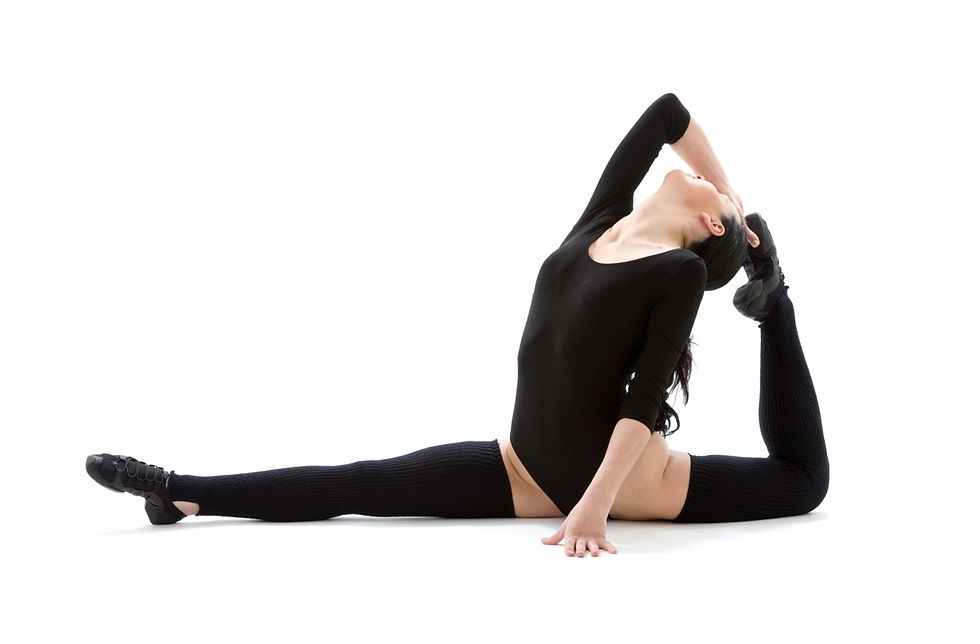
Let's talk about one of the most recognizable examples: oversplits. An oversplit is a split performed beyond 180 degrees, often with one or both legs elevated onto yoga blocks, a chair, a mat stack, or another surface. It can look impressive. But putting a leg on a block doesn't simply mean you're "getting a deeper stretch."
You're changing the position of the hip and increasing the range being demanded from the surrounding tissues. The concern is that repeatedly forcing the hip beyond its normal range can place stress on structures that are meant to help stabilize the joint.
Extreme hip range has been associated with problems including instability and impingement in dancers and gymnasts, particularly when excessive range is combined with poor control or other contributing factors. And an important question to ask is:
Can you actively control the range you're stretching into?
If the answer is no, simply pushing farther isn't necessarily making you a better athlete.
When Someone Else Is Doing the Stretching for You
Another practice we see is having someone else push an athlete deeper into a stretch.
For example:
Sitting on someone's back while they're in a straddle
Pushing down on someone's legs in a split
Pressing on their shoulders during a backbend
Having a partner force a limb farther into range
Adding weights or objects to force a joint deeper
The idea is usually:
"If I can get farther, I'll become more flexible."
But your body doesn't necessarily interpret that pressure as a productive flexibility exercise. External force can push a joint beyond the range the athlete can actively control, increasing stress on muscles and passive connective tissues. Dance medicine specialists specifically caution against using another person or added weight to force extreme ranges.
Your flexibility should not depend on someone else pushing you into a position your body can't reach on its own.
Why "More Flexible" Isn't Always Better
Flexibility is only one part of movement. Imagine an athlete who can lift their leg extremely high, but once their leg gets there, they can't control it. Or a gymnast who can move into an extreme shoulder position but doesn't have the strength to stabilize it. Or a dancer who can achieve an oversplit passively but cannot actively lift their leg to that same range.
That athlete may have a lot of passive range, but not necessarily a lot of usable range. And that's an important distinction.
Passive range = how far someone can be moved.
Active range = how far someone can move and control themselves.
For athletes, we want those two things to work together.

Stretching Shouldn't Be a Competition
One of the biggest problems with extreme stretching is that athletes can start comparing themselves to each other.
"She has a better split than me."
"Her leg goes higher."
"I need to get my heel to the floor."
"I need a deeper oversplit."
"Everyone else can do it."
Social media can make this even worse. But your ideal range of motion isn't necessarily the same as another athlete's. Bone structure, joint anatomy, tissue properties, training history, and natural mobility all influence how much range an individual can safely achieve. The American Orthopaedic Society for Sports Medicine recommends considering flexibility in a sport-specific and joint-specific way rather than assuming more overall flexibility is always better.
Your body doesn't need to look like someone else's to be a strong athlete.
So What Does Safe Stretching Look Like?
Safe stretching doesn't have to mean avoiding flexibility work altogether. In fact, flexibility can be an important part of athletic performance. The goal is to approach it differently.
Start with a warm body.
Stretching is generally better performed after an appropriate warm-up rather than forcing cold muscles and joints into end-range positions.
Move slowly and intentionally.
You shouldn't need bouncing, jerking, or another person forcing you deeper into a position.
Stretch the muscles, not just the joints.
If you consistently feel like you're hanging on your joints or locking into an extreme position, that may be a sign that you're relying on passive structures rather than muscular control.
Build strength in your range.
This is one of the most important pieces.
Instead of only asking:
"How can I get farther?"
Ask:
"How can I become stronger here?"
Active flexibility exercises, controlled end-range movements, and strength training can help athletes develop the ability to control the range they already have and gradually expand usable range when appropriate.
Don't stretch into pain.
A stretch may feel challenging or uncomfortable, but sharp, pinching, burning, or painful sensations are not something you should simply push through. The goal is to challenge tissues without forcing them beyond what they can safely tolerate.

Flexibility + Strength = Usable Range
For athletes, the goal shouldn't be to become as flexible as possible. It should be to develop the right amount of mobility for their sport and have the strength and control to use it.
Think about a dancer's développé. It's one thing to have someone lift your leg to your ear. It's another thing entirely to actively lift your own leg there, control it, maintain your alignment, and bring it back down. That's the difference between simply having range and owning your range. And that principle applies far beyond dance.
Gymnasts need to control extreme shoulder, hip, and spinal positions. Cheerleaders need mobility combined with strength and stability for stunts and tumbling. Figure skaters need hip and spinal mobility they can control while balancing and generating power. Martial artists need flexibility they can access quickly and safely.
The goal isn't just to reach the position. It's to be strong enough to control it.
The Bigger Picture
Stretching isn't inherently bad. Overstretching is the problem. There is a place for flexibility training in athletic development, but more isn't always better and extreme range shouldn't come at the expense of joint stability, strength, or control.
If an athlete needs more flexibility for their sport, the answer shouldn't automatically be "push harder." Instead, we should ask:
What range does this athlete actually need?
Do they have the strength to control it?
Are they using their muscles or hanging on their joints?
Is their flexibility helping their performance or creating instability?
At Performance Health & Rehab, we look at mobility as part of the bigger picture. Our goal isn't simply to help athletes become more flexible. It's to help them develop strong, controlled, usable movement that supports their sport and their long-term health.
Because the goal isn't to get your body into the biggest position possible.


Comments